Flooring is one of the most psychologically complex purchase decisions a homeowner makes. It sits at an unusual intersection of financial commitment, aesthetic anxiety, and practical consequence that makes it genuinely difficult in a way that most purchases are not.
Understanding that psychology — not just intuitively but precisely — is the key to designing a customer experience and a sales process that converts browsers into buyers. And understanding it also explains, with unusual clarity, why visualization tools work as powerfully as they do.
Why flooring is different from almost every other purchase
Consider what makes a flooring purchase uniquely challenging.
It is irreversible in a way that most purchases are not. You can return a sofa. You can repaint a wall for a few hundred pounds. Flooring, once laid, is effectively permanent. Removing and replacing it costs thousands in labour even before the materials. This creates a level of consequence that raises the psychological stakes of the decision significantly above a typical home furnishing purchase.
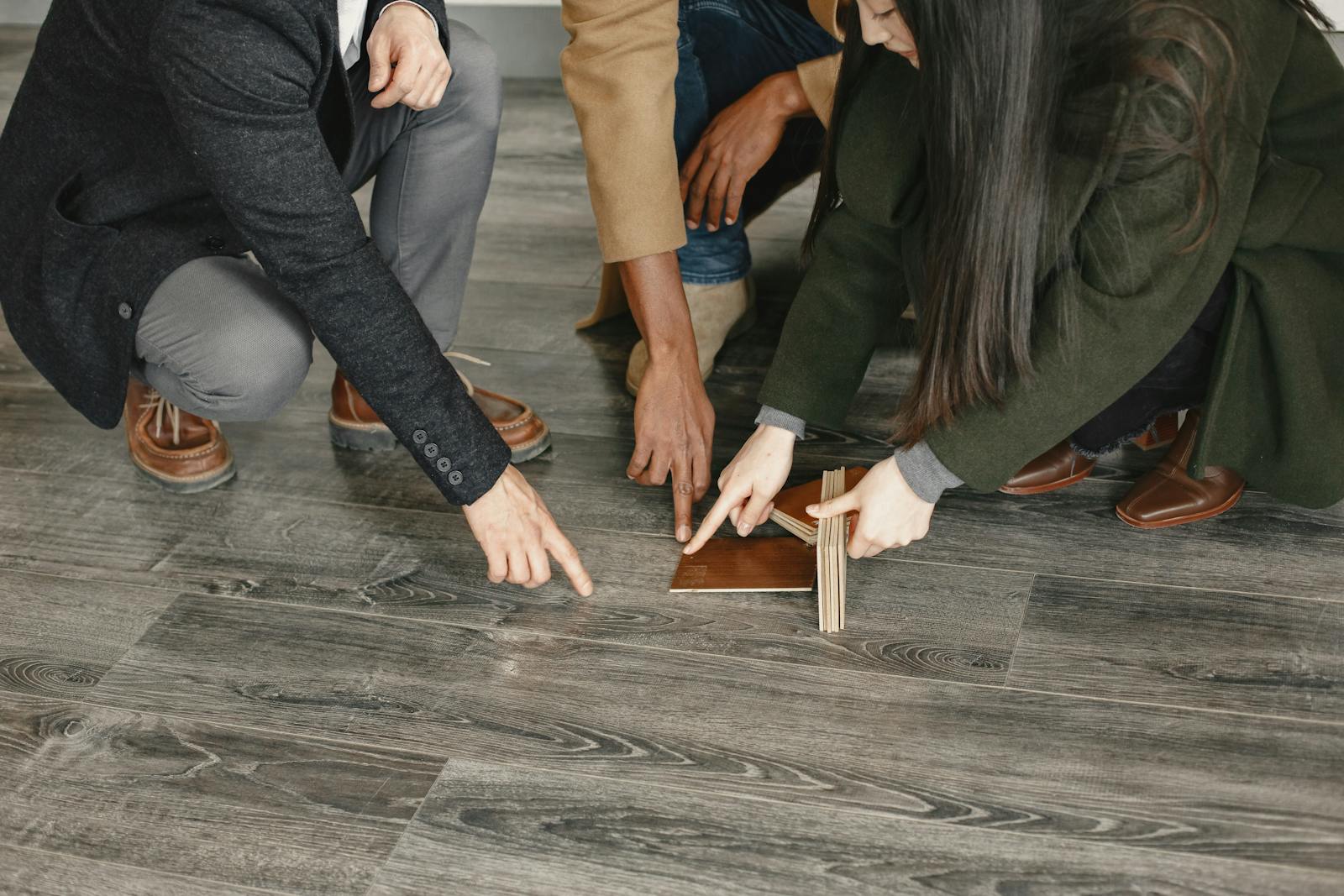
The product is experienced at scale, but purchased at sample. Almost every other product you buy, you can see at approximately the scale at which you will use it. You sit in the sofa before you buy it. You see the dining table fully assembled in the showroom. Flooring, by contrast, is experienced across dozens or hundreds of square metres, but purchased from a sample the size of a book. This creates a fundamental representational gap that the customer’s brain has to bridge through imagination — an act it finds genuinely difficult.
It has to work with everything else in the room. A flooring decision is not made in isolation. The customer needs to consider how the floor will interact with their existing furniture, wall colours, lighting conditions, skirting boards, and kitchen units. This contextual complexity adds another layer of uncertainty on top of the scale problem.
It is a background element that defines the whole room. Flooring is not the focal point of a room — it is the canvas on which everything else sits. Its rightness or wrongness is felt rather than noticed explicitly, which makes it hard to evaluate intellectually but intensely felt once it is in place.
These four factors combine to create a purchase environment with unusually high levels of uncertainty, risk perception and decision anxiety.
The psychology of hesitation
When a customer hesitates in a flooring showroom, their hesitation is almost never about the product itself. They are not unsure whether the tile is well-made or the wood flooring well-engineered. The hesitation is about the imagined outcome in their specific space.
The brain deals with this kind of uncertainty through what psychologists call loss aversion: the pain of a bad outcome (an expensive floor they hate) weighs more heavily than the pleasure of a good outcome (a beautiful floor they love), even when the probability of the bad outcome is low.
This asymmetry is why customers who are genuinely enthusiastic about a product in the showroom can still walk out without buying. Their enthusiasm is about the product in front of them. Their hesitation is about what it might look like at home. The emotional weight is on the potential downside, not the potential upside.
The job of the sales environment and the sales process is to address this directly — not by reassuring customers verbally (which research consistently shows is less effective than most salespeople believe) but by actually reducing uncertainty.
How visualization changes the psychological equation
When a customer uses a room visualizer to see their actual floor space tiled with the product they are considering, something specific happens in the decision-making process.
Uncertainty is replaced by information. The customer is no longer imagining an outcome — they are seeing one. The gap between the sample and the full floor experience narrows dramatically. The brain’s anxiety about the unknown is reduced because the unknown has been made visible.
Loss aversion is neutralised. The cognitive mechanism of loss aversion requires uncertainty — you can only fear a bad outcome if you cannot see what the outcome will be. When the visualizer shows a customer that the tile actually looks excellent in their room, the hypothetical bad outcome loses its emotional power. There is nothing left to fear.
Decision confidence increases. This is not simply a feeling — it is a measurable change in behaviour. Customers who have used a visualization tool purchase at meaningfully higher rates and express higher satisfaction with their purchases. The confidence they feel in the decision translates directly into willingness to commit.
The conversation shifts from uncertainty to excitement. This is the less quantifiable but equally important change. A customer who has seen their floor through the visualizer is not in a state of anxious deliberation. They are in a state of excited planning. The conversation shifts from “I’m not sure if it will look right” to “Now I need to figure out the wall tiles.” This is a completely different emotional state, and it is a much better starting point for a committed sale.
The role of the salesperson within this psychology
Understanding the psychology of the flooring purchase decision changes what good salesmanship looks like.
Traditional sales training emphasises handling objections — identifying the customer’s stated concern and addressing it with argument and evidence. This approach misdiagnoses the problem. The customer is not raising objections. They are expressing uncertainty. Arguing with uncertainty does not reduce it; it can actually increase it by making the customer more aware of the gap between the salesperson’s confidence and their own.
The more effective approach is to use tools that genuinely address the underlying uncertainty. The most powerful thing a salesperson can say to a hesitating flooring customer is not a persuasive argument — it is “let me show you what that looks like in your room.”
This reframes the salesperson’s role from advocate (trying to persuade) to advisor (helping the customer make a good decision). Customers respond to this differently. An advocate creates resistance; an advisor creates trust. And trusted advisors sell more, because customers make decisions they feel genuinely confident in.
After-purchase psychology: why confidence before buying reduces regret after
There is a well-documented phenomenon in consumer psychology called buyer’s remorse — the doubt and regret that can follow a significant purchase. For flooring, buyer’s remorse most often manifests as the customer getting home with their sample, holding it against the wall, and suddenly being less certain than they were in the showroom.
Visualization directly reduces post-purchase regret because the customer has already done the “hold it against the wall” exercise, in a much more sophisticated form, before they bought. They have seen the floor in their room. The decision was made with as much information as it is possible to have before installation. There is no hidden surprise waiting for them.
This matters to your business beyond the individual transaction. A customer who feels confident in their purchase becomes a source of referrals, positive reviews, and return business. A customer who experiences post-purchase regret does not.
Building the psychology of confidence into your customer experience
The practical implication of all of this is clear. Every point in your customer’s journey where they encounter uncertainty is a point where the right tool or the right conversation can either deepen their doubt or reduce it.
For flooring retailers and tile showrooms, the highest-value investment is in the tools and processes that reduce uncertainty at scale. Room visualization is the most direct and powerful of those tools — not because it is clever technology, but because it directly addresses the precise psychological mechanism that causes customers to hesitate.
When you understand that customers do not buy because they are not confident in the outcome, the right response is obvious: give them a way to see the outcome before they commit.
Related blog posts
- Why every tile showroom needs an AI room visualizer in 2026
- Selling large format tiles: why visualization is non-negotiable
- What is a Tile Visualizer? Complete Guide
Related resources and next steps
- Visual selling guide: Why AI Visualization is the Future of Stone Selling.
- Delivery-focused teams can use Builders & Contractors.
- Explore all capabilities in the Vizaye Features Hub.
- See category workflows in the Surface Material Solutions Hub.
- Review the Vinyl and SPC Flooring solution.
- See why visuals convert in Room Visualizer vs Traditional Sampling.
Ready to transform your surface material business?
Join businesses using Vizaye to visualize, sell, and grow faster.
🚀Try for Free